

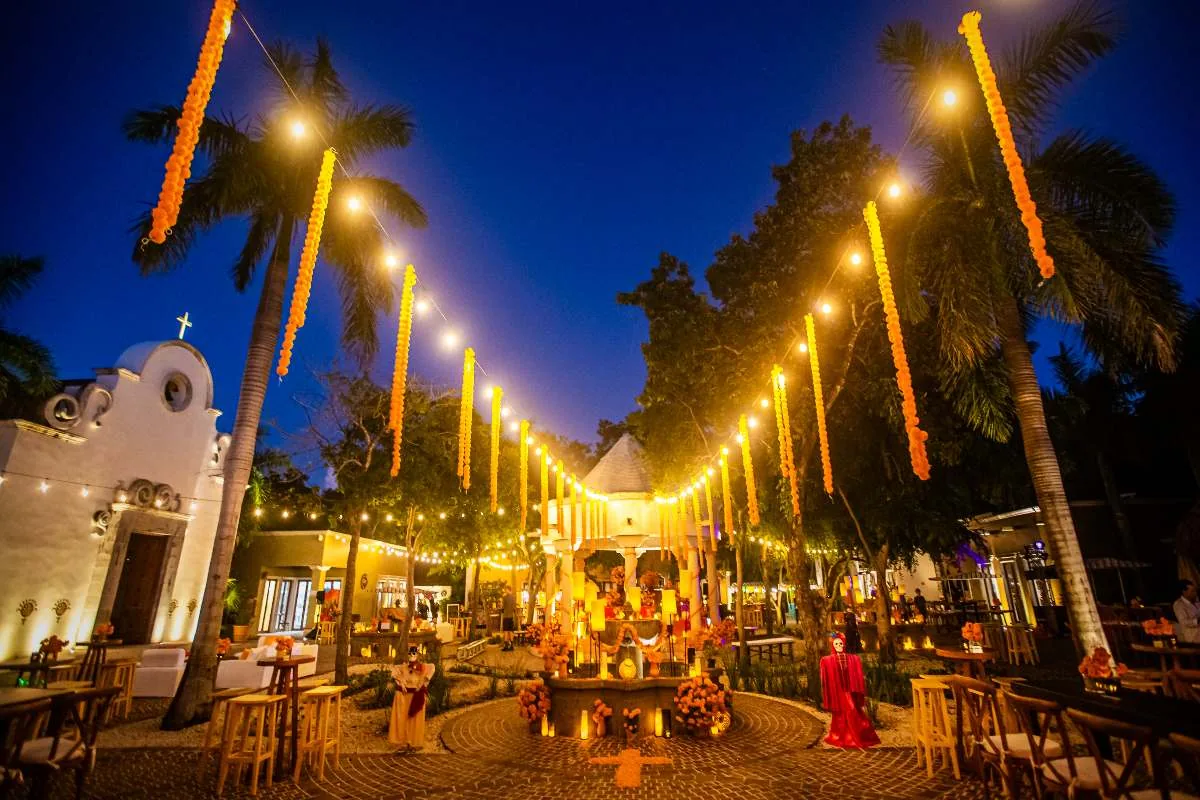
If you are planning a Day of the Dead trip to Mexico and will be in Cancún, Playa del Carmen or elsewhere in the Riviera Maya at the end of October, this is one of the most meaningful times of the year to look beyond the beach.
At its heart, Día de Muertos is an annual encounter between the living and the dead. Families prepare food, candles, photographs, flowers and personal objects for relatives who have died. UNESCO describes the tradition as a fusion of pre-Hispanic Indigenous rites and Catholic feasts, shaped differently by communities across Mexico rather than by a single national script.
That distinction matters. The public festivals are beautiful, and some are spectacular, but the tradition does not exist for spectacle. It exists because remembrance is treated as something active. The dead are not erased from family life. For a few days, a place is prepared for them at the table.
What Day of the Dead in Mexico actually means.
The modern celebration carries many histories at once. Indigenous beliefs about death, ancestry, agricultural cycles and the movement between worlds survived and changed through the colonial period, while Catholic All Saints’ and All Souls’ observances became part of the calendar. The result is neither purely pre-Hispanic nor purely Catholic. It is a living Mexican tradition that has kept adapting without losing its central idea: the dead remain part of the community through memory.
Ofrendas are built around that invitation. Photographs identify the person being remembered. Favourite foods and drinks make the altar personal. Water relieves the soul after its journey. Candles give light. Copal or incense marks a sacred space. Papel picado adds movement and colour. Cempasúchil creates a fragrant path back to the people waiting at home.
The point is not to make death look beautiful. It is to make memory present.

Candlelit graves show the intimate side of Día de Muertos: remembrance shared by families and communities.
Here, Día de Muertos also speaks Maya.
In Quintana Roo and across the Yucatán Peninsula, Hanal Pixán brings a distinctly Maya vocabulary, food tradition and rhythm to the season.
Xcaret is the Riviera Maya’s great public stage for Día de Muertos.
For travellers searching for Xcaret Day of the Dead or the Xcaret Festival of Life and Death, the event to know is the Festival de Tradiciones de Vida y Muerte. Xcaret’s official information lists the 2026 festival from 30 October to 2 November, with general festival hours from 16:00 to 22:30.
The 2026 edition is the festival’s twentieth and places Guanajuato in the role of invited territory. The wider programme combines regional altars and ofrendas with theatre, dance, workshops, food, crafts, exhibitions and concerts. Xcaret’s scale gives visitors one of the easiest ways to encounter many expressions of Día de Muertos in a single evening.
Its strength is also the reason to arrive with context. Xcaret is not a substitute for a family or community observance. It is a cultural festival that translates traditions for a large public. Go for the performances and atmosphere, but pay attention to the altars, food and regional details. Those are where the tradition stops being décor and starts becoming legible.
Programmes can change. Reconfirm the final 2026 schedule, ticket conditions and headline performances on Xcaret’s official festival page before booking transport or building the evening around a specific show.

Xcaret’s festival brings together altars, regional traditions, food, performance and contemporary cultural programming over four nights.
Why cempasúchil matters.
Few images are more closely associated with Día de Muertos than the saturated orange of cempasúchil, the Mexican marigold. The name comes from Nahuatl, commonly explained through words for twenty and flower, and the plant has deep pre-Hispanic associations.
Mexico’s Ministry of Agriculture notes that the Mexica associated the flower with the sun and believed its colour and strong scent could help guide the dead. That symbolism continues in contemporary ofrendas, where petals are often arranged into paths from an entrance towards the altar.
The result is practical, visual and spiritual at once. Cempasúchil does not simply make an altar look like Día de Muertos. It has a job to do. It marks the route home.

Cempasúchil is both symbol and guide, its colour and scent used to mark a path towards the ofrenda.
Mexico does not celebrate Día de Muertos in only one way.

Public celebration adds music, dress and performance to a tradition whose meaning begins with remembrance.
That variety is part of the tradition’s strength. A comparsa in Oaxaca, a candlelit cemetery in Michoacán and a Maya Hanal Pixán altar in Quintana Roo can all belong to the same season without being interchangeable.
For travellers, the useful question is not which version is the “most authentic”. It is whose tradition you are seeing, what it means locally and whether the space is public, communal or private.
From family altars to fashion, nightlife and cinema.
One reason Día de Muertos has remained culturally powerful is that it continues to absorb the present. Contemporary Mexico does not preserve the tradition by pretending the twentieth and twenty-first centuries never happened. Designers, artists, chefs, photographers, musicians and filmmakers keep finding new ways to work with memory.
Its influence now reaches spaces far removed from the family altar. In Mexico City, the Vogue Día de Muertos Gala 2026 is scheduled for 22 October. Its theme, Espíritu monumental: Miradas al muralismo femenino, links the season of remembrance with the work and memory of women muralists. We mention the gala here as evidence of how far the cultural language of Día de Muertos has travelled, not as a substitute for the tradition itself.
In Atlixco, Mezcal Amarás has developed its Boda de Muertos as a modern social event built around the season, combining food, mezcal, dress, music and visual references to Día de Muertos. It is deliberately contemporary. That contrast is part of the point. The same season can hold a private altar at home, a community vigil, a fashion gala and a late-night party without making them the same kind of experience.
Cinema has accelerated that international visibility. Pixar’s Coco placed ofrendas, marigold paths and family remembrance at the centre of a global story. Another kind of cultural feedback loop came from the 2015 James Bond film Spectre. Its fictional Mexico City parade helped inspire the city’s first large-scale Día de Muertos parade the following year. A movie invented a spectacle, then the city made a version of it real.

The visual language of Día de Muertos now appears across hospitality, dining, fashion and contemporary cultural events.
Día de Muertos now has a visible life far beyond Mexico.
The strongest international events tend to work best when Mexican communities and cultural institutions remain part of the telling.
Come curious. Leave the costume mindset at the door.
The Riviera Maya makes Día de Muertos unusually accessible to visitors. That does not mean every part of it is designed for visitors. A public festival at Xcaret is different from entering a cemetery in a community where families are holding vigils. Treat the context accordingly.
- Start with Xcaret if you want a structured, family-friendly introduction with performances, food, altars and regional cultural programming in one place.
- Look for Hanal Pixán programming in Quintana Roo if you want to understand the Maya expression of the season rather than only the national iconography.
- Ask before photographing people, private altars or cemetery rituals. A beautiful scene can still be someone else’s intimate family moment.
- Do not touch or rearrange an ofrenda. Its objects have been placed deliberately, often for a specific person.
- Wear what you would wear to a cultural evening, not what you would wear to a Halloween costume contest, unless an organised event explicitly invites themed dress or face painting.
- If you want deeper context, book a local guide or concierge who can distinguish public events from community spaces and explain what you are seeing without turning the tradition into a checklist.
The Riviera Maya version in one glance.
Day of the Dead in the Riviera Maya.
Straight answers for travellers planning Día de Muertos around Cancún, Playa del Carmen and Xcaret.
When is the Xcaret Day of the Dead festival in 2026?
Xcaret’s current official festival information lists the Festival de Tradiciones de Vida y Muerte from 30 October to 2 November 2026. The general festival page lists hours from 16:00 to 22:30. Recheck the final programme before you travel because individual performance times and access conditions can change.
Is Xcaret a good place to experience Day of the Dead?
Yes, especially for a first visit. Xcaret brings altars, food, performance, workshops and regional traditions into one organised festival. It is a public cultural event, not a substitute for a private family or community observance, so it is best experienced as an introduction to the tradition rather than the whole story.
What is Hanal Pixán?
Hanal Pixán is the Maya tradition associated with the season in the Yucatán Peninsula, including Quintana Roo. The name is commonly translated as “food of the souls”. Altars, candles, flowers and regional foods are prepared for deceased relatives, expressing a continuing bond between the living and the dead.
Why is cempasúchil used for Day of the Dead?
Cempasúchil is the Mexican marigold associated with the sun, remembrance and the path of returning souls. Its intense colour and scent are traditionally used to mark routes towards the ofrenda and to decorate altars and graves.
Is Día de Muertos the same as Halloween?
No. The dates are close, and contemporary events can borrow visual language from one another, but Día de Muertos is a Mexican remembrance tradition centred on deceased relatives, ofrendas, food, flowers, candles and community ritual. Halloween has a different history and cultural function.
Where are the most famous Day of the Dead celebrations in Mexico?
Pátzcuaro and Janitzio in Michoacán, Oaxaca, San Andrés Mixquic in Mexico City and communities across the Yucatán Peninsula are among the best-known places, but their rituals differ. There is no single “authentic” version that represents the entire country.
Can children attend Xcaret’s Day of the Dead festival?
Xcaret describes the festival as suitable for the whole family. Families should still check the current ticket rules, performance times and transport plan before visiting, especially if they want to stay through the later evening programme.
What should travellers wear for Día de Muertos in the Riviera Maya?
For Xcaret or another public cultural event, comfortable evening clothing and walking shoes are the safest choice. The tradition is not an invitation to dress in a generic “Mexican skull” costume. If an organised event specifically offers face painting or themed dress, follow that event’s guidance and keep the context respectful.
See the festival. Understand the tradition.
Tell us where you are staying and how you want to experience Día de Muertos. We can help shape an evening around Xcaret, local dining and the cultural context that makes the season worth travelling for, without reducing it to a photo opportunity.


Leave a Reply
You must be logged in to post a comment.